Content Maxxing: How to Test, Repurpose and Track Every Video Without Burning Out
Content maxxing is the new norm: test versions with trial reels and YouTube A/B tests, repurpose the winner for each platform, and track what works.
Sam · · 14 min read
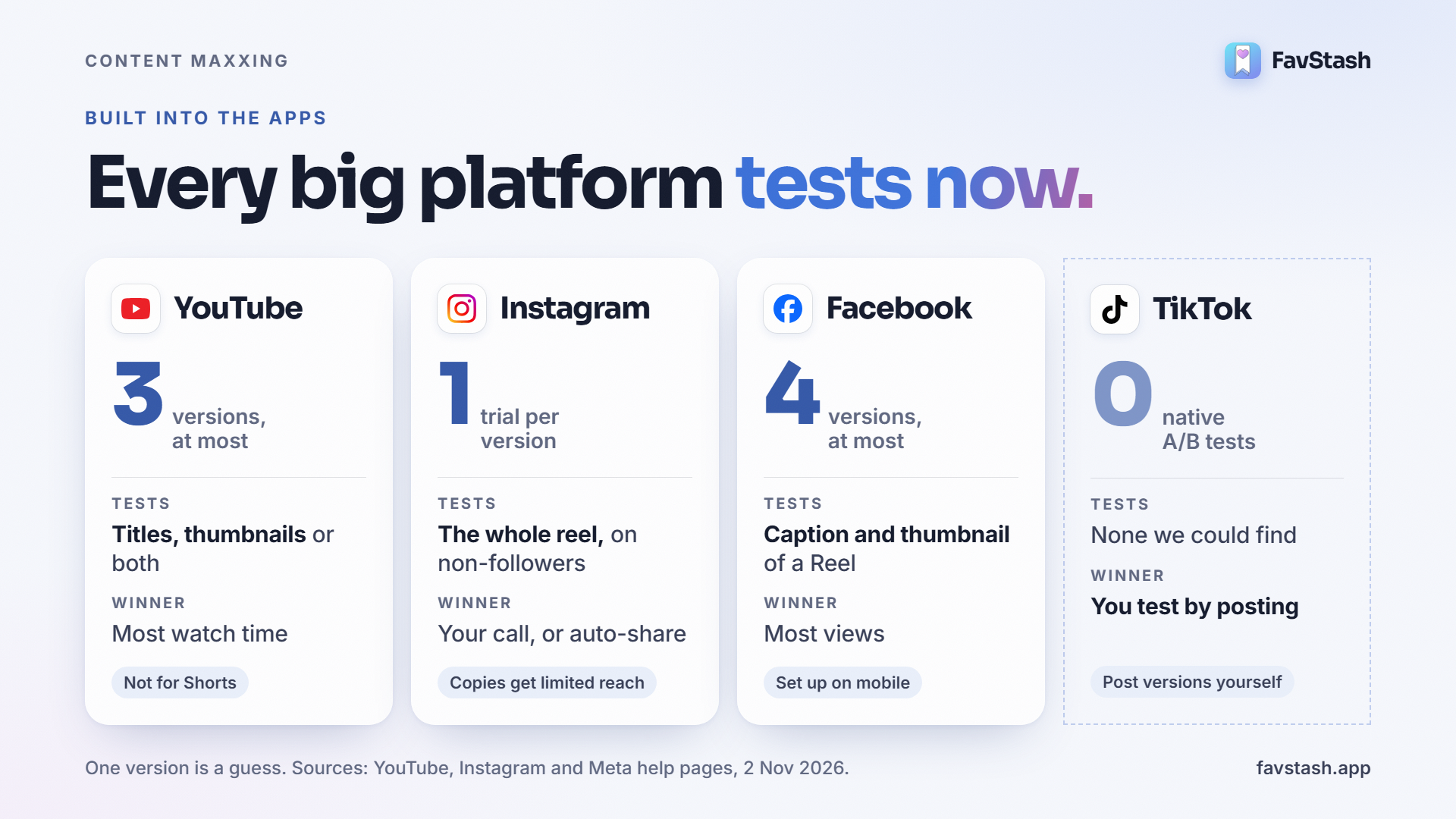
Every big platform now has a built-in way to test more than one version of a post. YouTube lets you A/B test up to three titles or thumbnails and keeps the one that earns the most watch time. Instagram's trial reels show a version to people who don't follow you before your followers see it. Facebook lets you run up to four caption-and-thumbnail versions of a Reel. Creators have to utilise these features to improve how they reach out to their audience and in-turn increase their auidence.
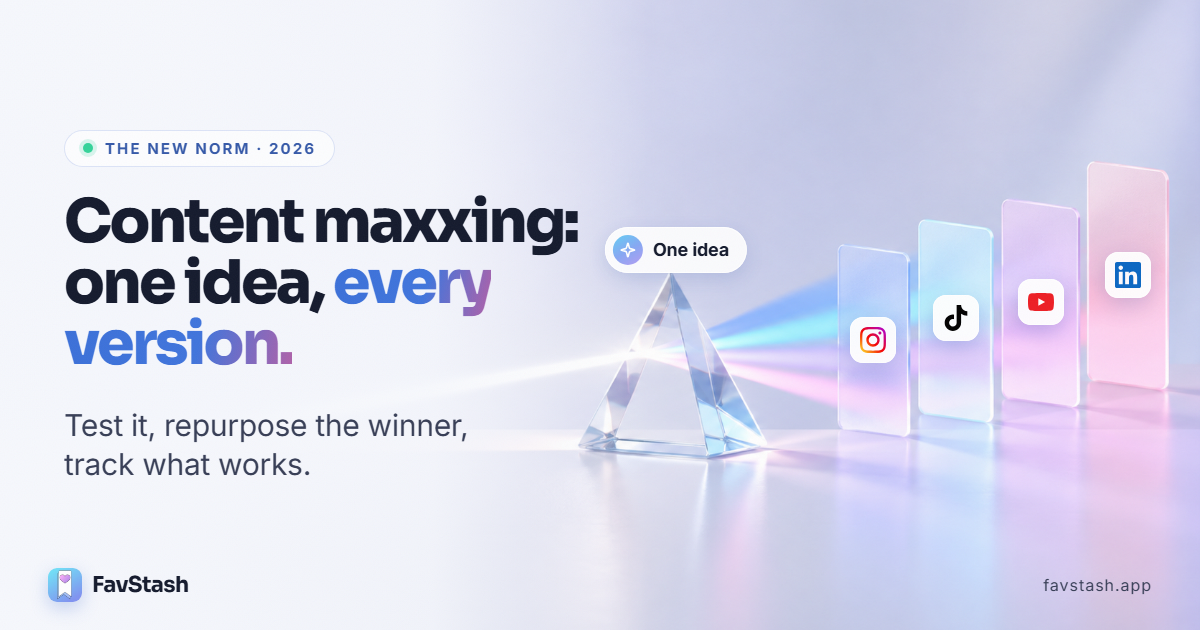
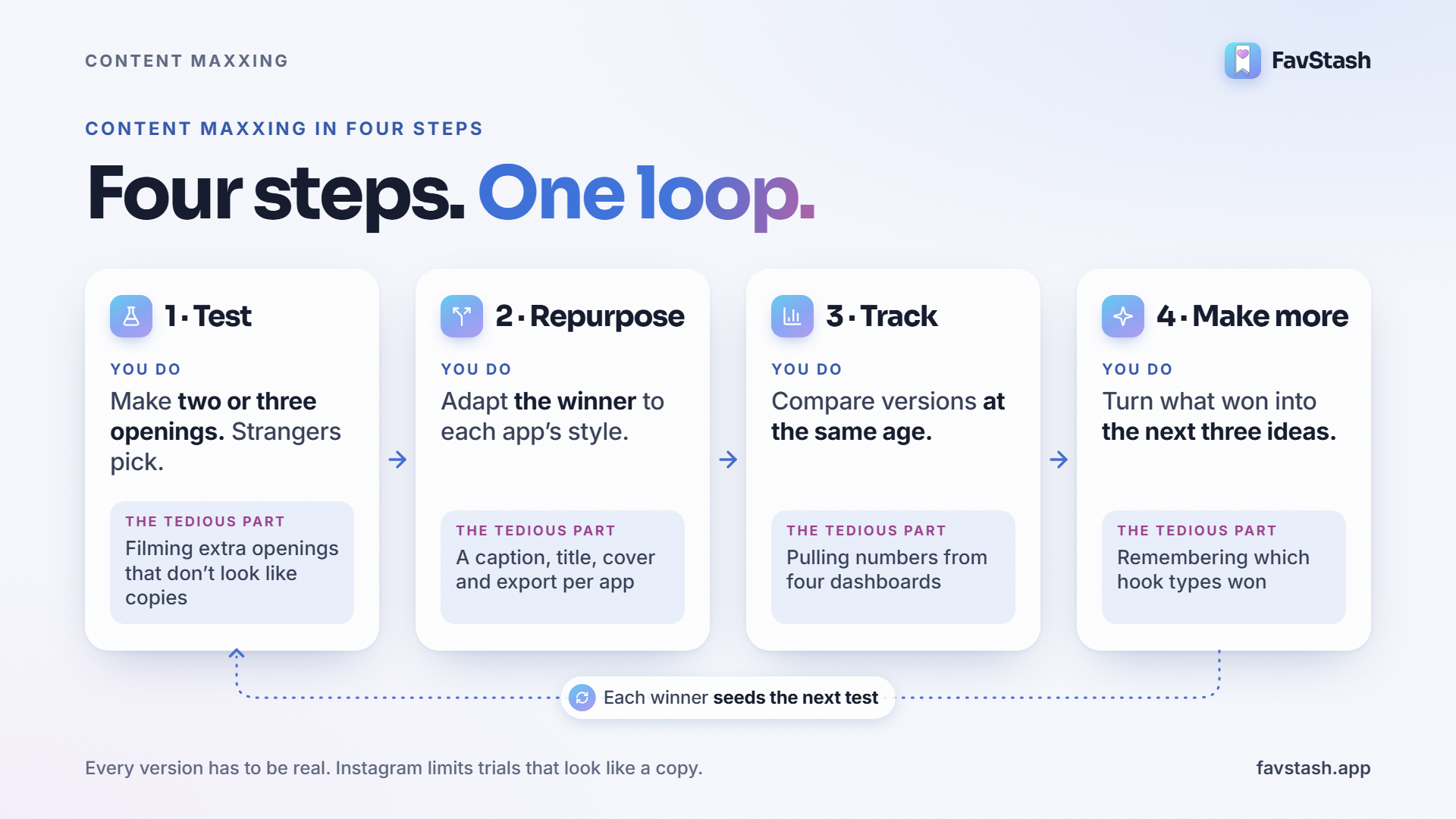
That's content maxxing: test versions of each video, repurpose the winner for every platform's style, track what works and make more of it. This is quickly becoming the default way to run short-form video, and done by hand it's tedious. You re-cut openings, re-export, rewrite captions for each app, schedule everything, then compare numbers across four dashboards. This guide covers the loop, what each step needs, and the parts you can hand to tools, including our free, open-source AI video editing skills and FavStash.
Key Points#
- Testing is built in now. YouTube tests titles and thumbnails by watch time, Instagram tests whole reels on non-followers, and Facebook tests up to four versions of a Reel.
- Content maxxing is a four-step loop: test versions, repurpose the winner for each platform, track what works, and make more of it.
- The idea isn't the hard part. The versions are: extra openings, re-exports, a caption per app, schedules, and comparisons across dashboards.
- Every version has to be real. Instagram limits trials that look like something you've already shared, so copies with a new caption stopped working in 2026.
- AI can take most of the busywork. Our free video editing skills let Claude Code or Codex write the openings, edit the cut, prepare variants that won't be held as duplicates, and schedule once you approve.
- Start with one idea this week. Connect your accounts to FavStash and run your first test. The free plan doesn't even need a card.
The short answer#
| Step | What you do | Built-in platform help | The tedious part |
|---|---|---|---|
| 1. Test | Make two or three versions of the opening and let viewers pick | Instagram trial reels, YouTube A/B tests, Facebook Reel tests | Writing and filming extra openings, then making sure none look like a copy |
| 2. Repurpose | Adapt the winner to each platform's style: TikTok, Shorts, a carousel, LinkedIn | None. Every app has its own fields and formats | A new caption, title, cover and export for every app |
| 3. Track | Compare versions and platforms after the same number of days | Each app's own insights | Pulling numbers from four dashboards into one view |
| 4. Make more | Turn what won into the next three ideas | None | Remembering which hook types won, and finding the next reference |
How we checked. Platform features come from YouTube's, Instagram's and Meta's help pages and announcements, read on 2 November 2026. Creator experiences come from r/InstagramMarketing threads from July to October 2026 and are linked where we use them. The skills described below are our own open-source project. We haven't measured a reach increase for this loop, so we don't quote one.
Why content maxxing is the new norm#
The platforms built testing into their own apps:
| Platform | What you can test | Versions | How the winner is picked | Limits |
|---|---|---|---|---|
| YouTube | Titles, thumbnails, or both | Up to 3 | Highest watch time, within about two weeks | Desktop Studio only; not available for Shorts |
| The whole reel, shown to non-followers first | One trial per version | Your call from insights, or auto-share based on early performance | 200 followers (professional) or 1,000 (personal); copies get limited reach | |
| Caption and thumbnail | Up to 4 | The version with the most views | Set up from mobile when you create the Reel | |
| TikTok | No native A/B test we could find | You test by posting |
A platform that ships an A/B tool is telling you that one version is a guess. Creators who test get better openings, titles and covers over time, and the ones who don't are competing against that.
Each platform also rewards its own style. A Short needs a title, a YouTube caption becomes the description, a carousel works slide by slide, and a TikTok caption reads differently from an Instagram one. A single upload pasted everywhere fits no platform well.
The shortcuts have also closed. Instagram's help page warns that a trial "may get limited reach if Instagram detects that you've previously shared the same content," and a creator with a 400K-follower account said reruns of old reels as trials collapsed in October 2026: "the 'golden age' of trial reel reruns is over." Since Instagram's April 2024 ranking update, recommendations also show the original in place of reposts. Content maxxing works when each version is genuinely new or genuinely native to its platform.
Step 1: Test versions of the opening#
Most viewers decide in the first few seconds, so the opening is the best place to test. On Instagram, post each version as a trial reel. Trials reach only people who don't follow you, and Instagram says they're "evaluated independently" from your regular reels. On long-form YouTube, use the built-in A/B test for the title and thumbnail.
The catch in 2026 is duplicates. Creators report that versions sharing the same footage get held with a "looks like something you've shared before" warning, even when the spoken hook was re-recorded. What helps:
- Change the first shot as well as the line: a new angle, framing, location or B-roll.
- Post the strongest version first, untouched.
- Give each other version its own whole-frame look (a slight punch-in, a different grade) and its own cover.
- Keep automatic sharing off and share only the winner.
Our guide to how to post trial reels and test three hooks walks through each step.
Step 2: Repurpose the winner for each platform#
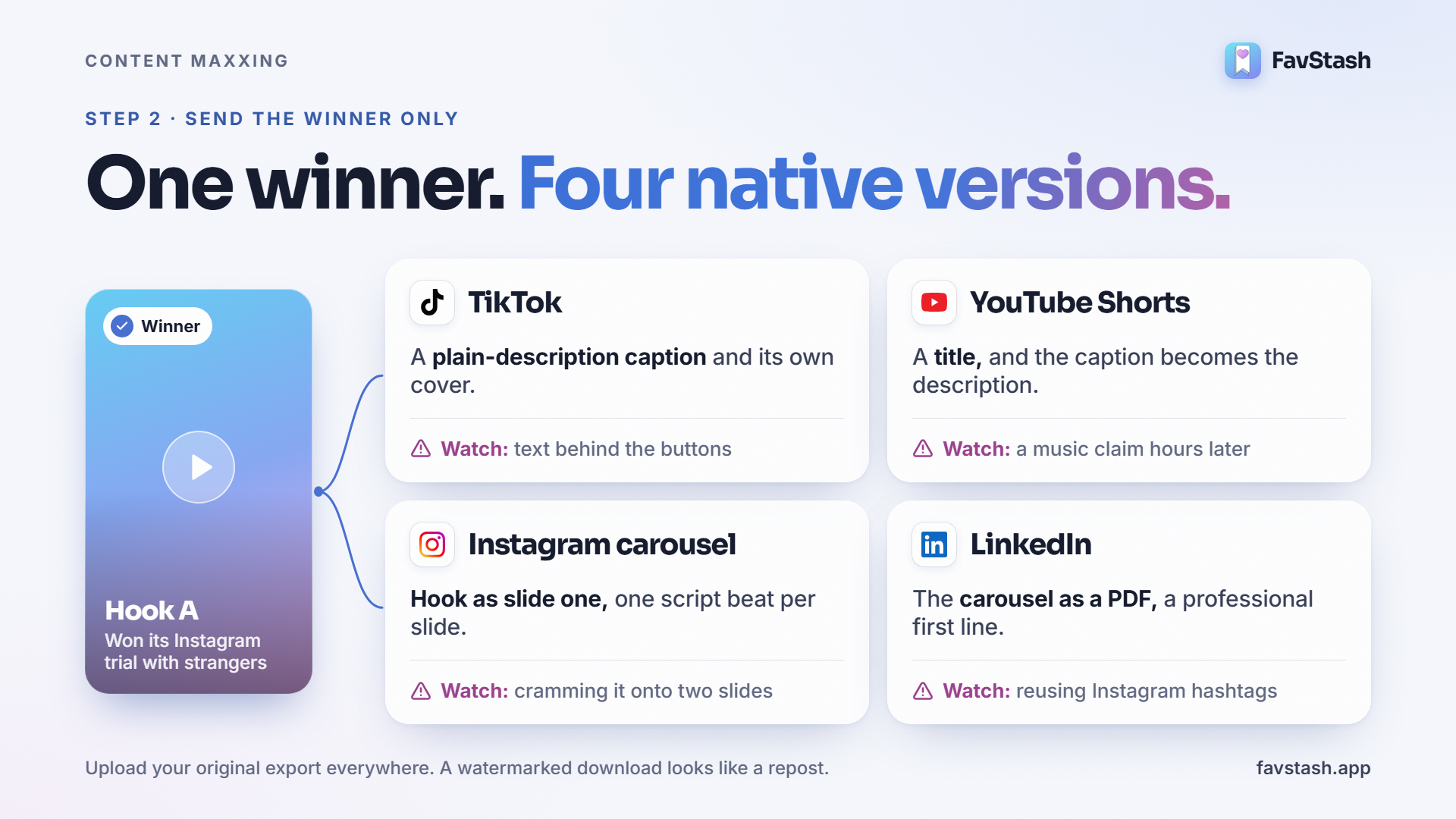
Once a version has won with strangers, it's your best candidate everywhere else. Send the winner only. The losing versions have already shown they don't open well.
| Where | What to change | Watch out for |
|---|---|---|
| TikTok | Caption written as a plain description of the topic, plus its own cover | Text hidden behind TikTok's buttons and caption area |
| YouTube Shorts | A title, and a description (the caption becomes the description) | A copyright claim on the music a few hours after posting |
| Instagram carousel | Hook as slide one, one script beat per slide, the takeaway last | Cramming the whole script onto two slides |
| The carousel as a PDF, and a first line written for a professional feed | Reusing Instagram hashtags |
Upload your original export to every platform. A download from another app with its watermark on it looks like a repost. As the creator of the video, you're the original that Instagram's ranking favours, as long as you post a clean file.
Step 3: Track what actually works#
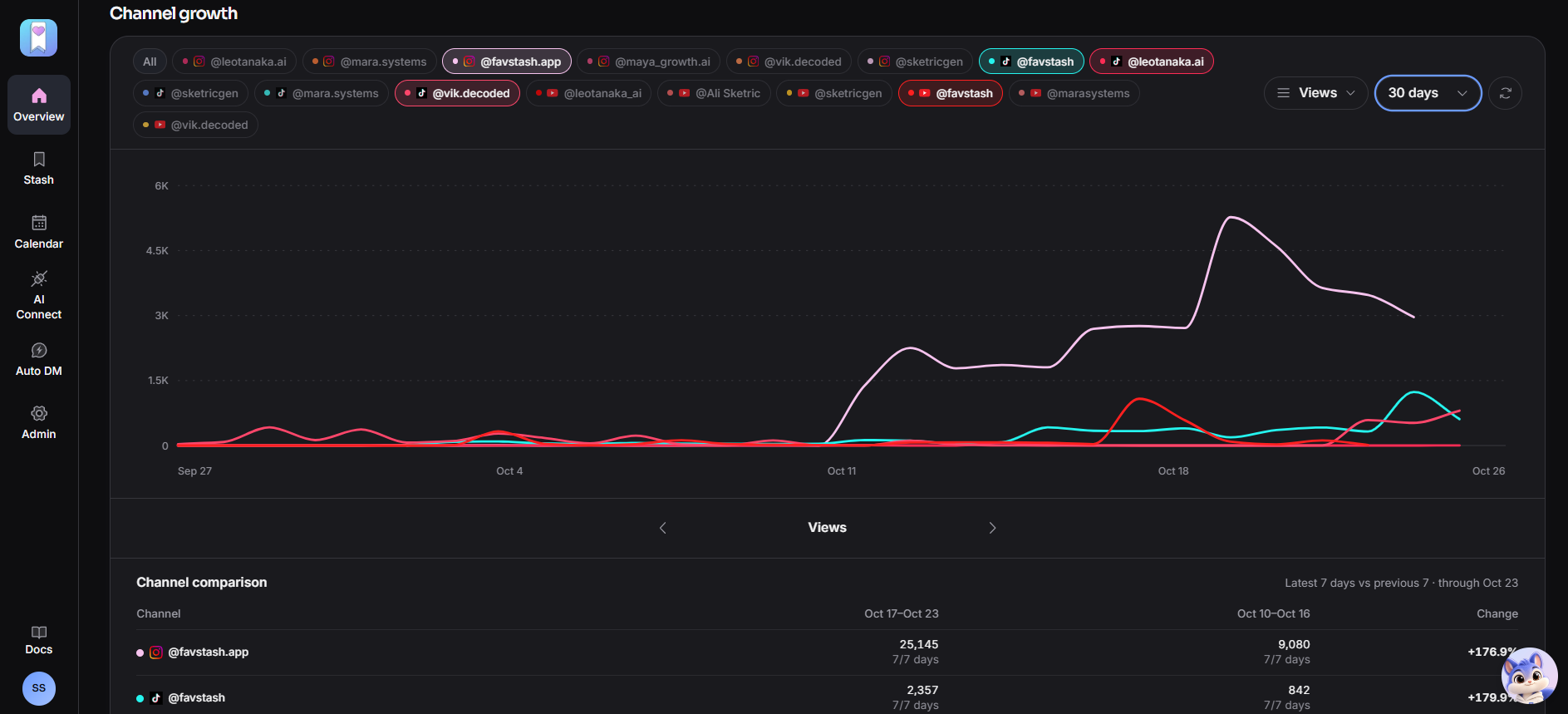
Compare versions at the same age, usually after two or three days, and compare each platform with its own past posts rather than with the others. Instagram shows a trial's views, likes, comments and shares within about 24 hours. YouTube's A/B test reports its winner when the test finishes.
A short log beats memory:
| Idea | Version | Hook type | Platform | Views at day 3 | Shares | Winner? |
|---|---|---|---|---|---|---|
| Hook testing | A | Result first | Instagram trial | |||
| Hook testing | B | Problem first | Instagram trial | |||
| Hook testing | A | Result first | TikTok |
Decision rule: if the best and worst versions are within about 20% of each other, the opening wasn't what held the video back, so test a new idea next. That 20% is our rule of thumb. If people leave in the first two or three seconds, rebuild the opening before you touch the body.
Step 4: Make more of what works#
This is where the loop starts paying back. After a month of logs you'll know which hook types, formats and topics win for your audience. Each winner becomes the template for your next three ideas: the same hook type on a new topic, or the same topic in a new format.
Use outside evidence too. A reel is worth adapting when it beat its own creator's usual numbers by a wide margin, say three times their median views. A reel that merely has big numbers on a huge account doesn't count. Adapt the hook, structure and pacing, and film it yourself.
Pro tip: keep a short "next test" note after every comparison. One line, such as "try a question hook on the pricing topic," saves you from planning next week from scratch.
The tedious parts, and how to hand them off#
| Job | By hand | With AI and FavStash |
|---|---|---|
| Finding a proven idea | Scrolling and guessing | Search your saved reels by what was said, and spot reels that beat their creator's usual numbers |
| Writing extra openings | A blank page, three times | Openings in your voice, each using a different hook type, with a shot list for each |
| Editing the variants | Re-cutting and re-exporting each one | One edit, with a separate treatment and cover for each variant and a duplicate check |
| A caption per platform | Rewriting for every app | Drafted for each platform, for you to approve |
| Scheduling | Four apps, four uploads | One approval, posted to every channel |
| Comparing results | Four dashboards | One ranked view across Instagram, TikTok and YouTube |
Free AI video editing skills for content maxxing
We publish FavStash Creator Skills, ten free, open-source skills (Apache-2.0) that teach Claude Code, Codex, Cursor or any skills-aware agent to run the short-form loop on your own computer. Each one maps to a step above:
| Skill | Content maxxing step | What your agent does |
|---|---|---|
| find-ideas | Make more | Finds reels worth adapting (at least 3× their creator's median views), reads your saved inspiration and your own outliers, and suggests what to make next |
| write-script | Test | Copies a proven hook as opening A, writes extra openings that each use a different hook type, writes one shared body in your voice, and gives you a filmable brief |
| edit-video + 6 styles | Test, repurpose | Cuts your takes, removes retakes, and adds captions, sound and motion graphics inside each app's safe areas. The styles are adaptive-glass, paper-grid, breakout-card, product-motion-ads, motion-effects and text-over-footage |
| publish-and-analyze | Test, repurpose, track | Exports at full quality, picks a real-frame cover for each variant, applies a different whole-frame treatment to each variant and checks it against your earlier posts so it isn't held as a duplicate, schedules after you approve, and compares variants at equal ages |
The duplicate step is the one creators complain about most. One creator said dodging Instagram's check by hand took about an hour per video. publish-and-analyze makes that a routine step. Your agent posts the strongest variant first and untouched, gives each other variant its own punch-in, grade and cover, and checks every file against your past posts and against the other variants before anything is queued.
Editing runs locally with FFmpeg and HyperFrames, and your footage stays on your machine. Nothing is uploaded or scheduled until you approve the exact file, caption, account and time. To install, give your agent this prompt:
Set up FavStash creator skills for my short-form workflow.
Clone https://github.com/alisadiq-ai/favstash-ai-video-editing-skills and follow:
https://raw.githubusercontent.com/alisadiq-ai/favstash-ai-video-editing-skills/main/INSTALL_FOR_AGENTS.md
The skills work without FavStash. See the setup guide in our docs.
FavStash closes the loop
With FavStash connected, the same agent can search the Reels and TikToks you've saved by what was said, schedule approved cuts to Instagram (including trial reels), TikTok, YouTube, LinkedIn and X, and rank your results in cross-platform analytics to choose the next test. A prompt for the repurpose step:
Find my best Instagram reel from the last 14 days by views.
Write a TikTok caption and a YouTube Shorts title for it in my voice.
Schedule the original export to TikTok tomorrow at 7pm and to
YouTube Shorts on Friday at 7pm, after I approve.
Where it falls short: FavStash doesn't publish to Facebook, Threads or Pinterest, LinkedIn posting is for personal profiles only, and its analytics don't cover LinkedIn. Other schedulers, including Buffer, Later and Metricool, publish trial reels too. The free plan includes 4 posts a month, enough for one three-version test.
A weekly content maxxing loop#
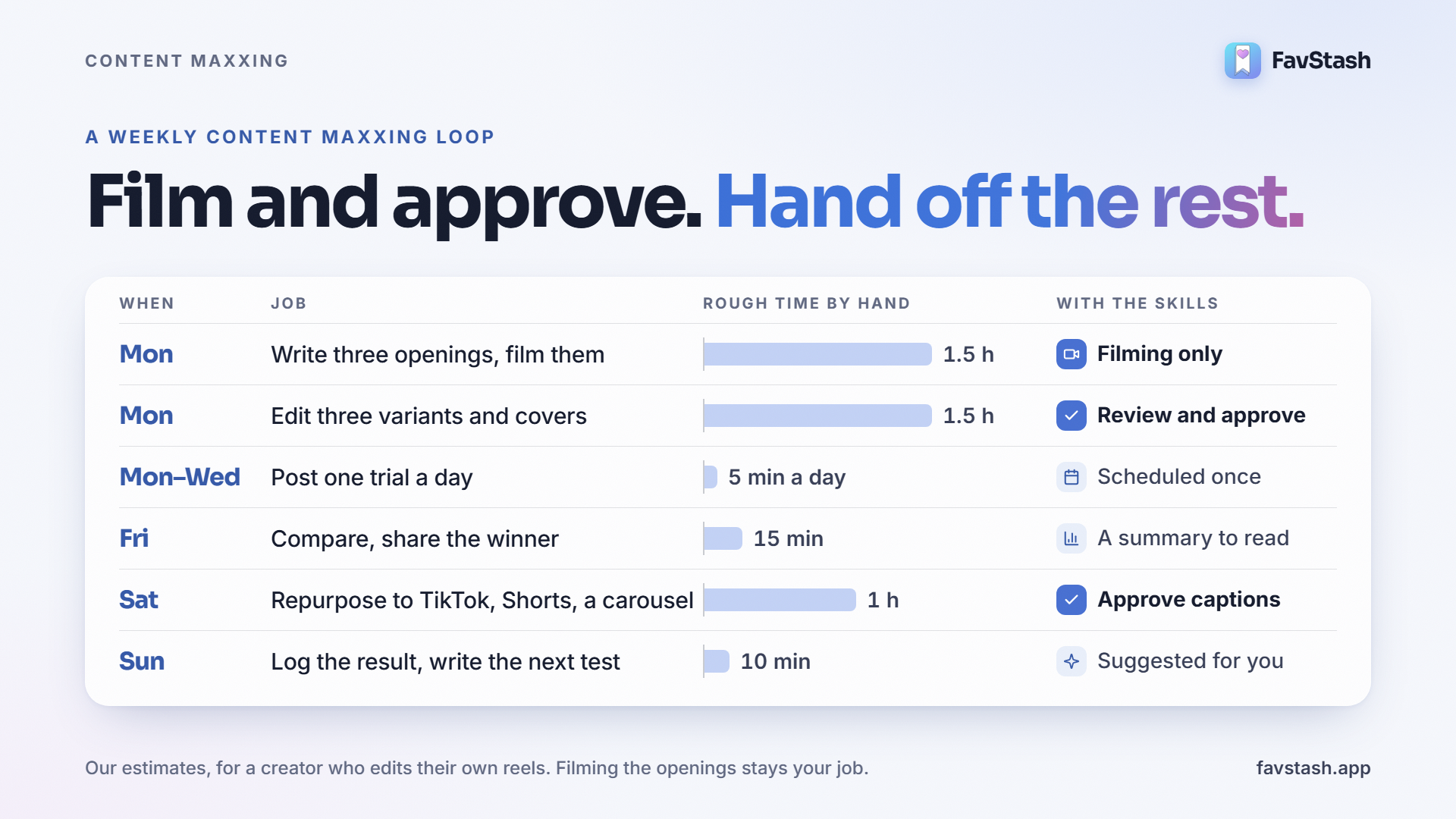
| When | Job | Rough time by hand | With the skills |
|---|---|---|---|
| Monday | Pick an idea, write three openings, film them | 1.5 hours | Filming only |
| Monday | Edit three variants and covers | 1.5 hours | Review and approve |
| Monday to Wednesday | Post one trial a day | 5 minutes a day | Scheduled once |
| Friday | Compare, then share the winner to everyone | 15 minutes | A summary to read |
| Saturday | Repurpose to TikTok, Shorts and a carousel | 1 hour | Approve captions |
| Sunday | Log the result, write the next test | 10 minutes | Suggested for you |
The times are our estimates for a creator who edits their own reels. Filming the openings stays your job. Most of the rest is review.
Common mistakes#
- One file, three captions. Instagram treats that as one video posted three times.
- Re-running old reels as trials. Make a new opening on an old idea instead.
- Repurposing the losers. If a version lost with strangers on Instagram, it gets no credit on TikTok.
- One caption everywhere. Each app has its own fields and its own voice.
- Judging trials against your main feed. Different audiences give different numbers.
- Testing forever without logging. A winner you don't write down won't help next week's plan.
What practitioners are saying#
The upside is real. One creator running a three-hook workflow said trials brought them two to three times the views of their main feed.
So is the workload. In a thread about the 2026 duplicate warnings, one reply said making separate content for trials: "It literally doubles the work and for only very sporadic reward." That's the exact problem content maxxing tools should solve. If only the first five seconds are filmed three ways and an agent handles the variants, the extra work is a few minutes of review.
Author's take#
The platforms have already made their choice. YouTube, Instagram and Facebook all built testing into their apps, so posting one version and hoping is now the slow way to grow.
The bottleneck has moved from ideas to versions. Most creators already have enough ideas. What they don't have is the time to make, check, adapt and compare three versions of each one. My rule: automate everything except filming and approving. Film the openings yourself, approve every post yourself, and hand the cutting, treating, captioning, scheduling and comparing to tools. That's how a three-version test fits into a normal week, and how the winners start adding up.
What's ahead#
We're writing a guide for each step:
- How to post trial reels: the three-hook method
- How many trial reels you can post a day (coming soon)
- Cross-posting your winners to TikTok and YouTube Shorts (coming soon)
- Are trial reels worth it? (coming soon)
- How to test hooks on Reels, TikTok and Shorts (coming soon)
- Reel or carousel: turning a winning reel into slides (coming soon)